Outsourced Customer Support Pricing: What Drives the Cost and How to Compare Quotes
By Hamza Ali · Nov 9, 2026 · 8 min read
"How much does outsourced customer support cost?" is usually the first question businesses ask, and the honest answer is that it depends on a handful of factors you can control. Two companies with the same number of customers can receive very different quotes because their channels, hours and ticket complexity are different.
This guide explains how providers price support, what moves the number up or down, and how to compare quotes so you are judging like for like.
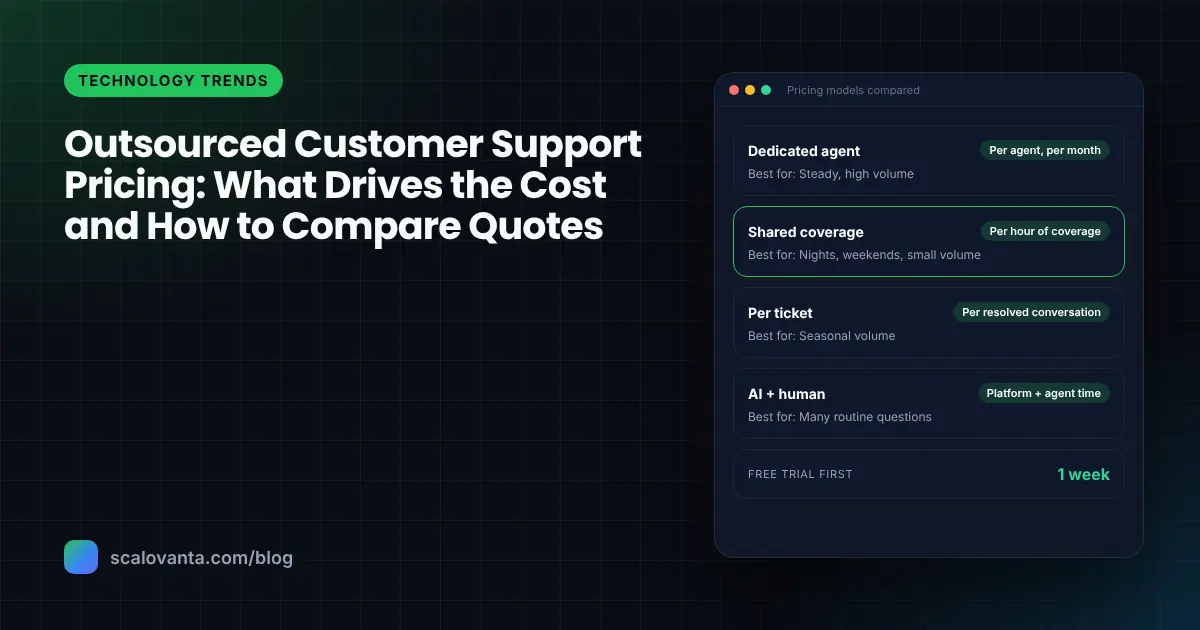
The four common pricing models
1. Dedicated agent (per agent, per month)
You pay a monthly fee for each full-time agent who works only on your account. This suits steady, high volume and products that need deep knowledge. It is predictable, but you pay for the agent's time whether volume is high or low.
2. Hourly or shared coverage
You pay for hours of coverage from a shared, trained team. This suits smaller volumes, overnight and weekend coverage, or businesses that want to start small. Check whether the hours are guaranteed and how many accounts each agent covers.
3. Per ticket or per conversation
You pay for each resolved email, chat or call. It ties cost directly to volume, which helps seasonal businesses, but make sure "resolved" is clearly defined and that complex tickets are not priced the same as simple ones in a way that encourages rushed answers.
4. Hybrid and AI-assisted
Many providers now combine an AI assistant for routine questions with human agents for everything else. Pricing may include a platform or AI component plus human coverage. Ask how AI answers are checked, and what share of conversations you should expect the AI to handle on its own.
What changes the price
- Volume and seasonality: how many conversations you receive, and how sharply that spikes around sales, launches or holidays.
- Channels: email is usually the most efficient; live chat and phone need agents available in real time; social and marketplace inboxes add their own tools.
- Coverage hours: business hours in one time zone cost less than evenings, weekends or 24/7 coverage across the USA and UK.
- Complexity: order status and returns are faster to handle than technical troubleshooting, B2B account issues or regulated topics.
- Language and region: native-level English for US and UK customers, or additional languages, affects who can staff your account.
- Dedicated versus shared: dedicated agents cost more but learn your product in depth.
- Extras: QA programmes, reporting, onboarding projects, knowledge-base writing and tool setup may be included or charged separately.
Hidden costs to ask about
- One-off setup or onboarding fees.
- Minimum monthly commitments or minimum contract length.
- Charges for extra hours during peaks, and how much notice they need.
- Who pays for helpdesk or chat-tool seats used by the agents.
- Notice periods and fees if you want to change scope or end the contract.
How to compare quotes fairly
Quotes are only comparable when they describe the same service. Before comparing prices, send every provider the same brief:
- Your weekly volume by channel, with a busy-week example.
- The hours and time zones you need covered.
- Your top ten contact reasons with a few anonymised examples.
- Your helpdesk and chat tools.
- The response-time targets you expect for each channel.
Then compare on the same five points for each provider: the pricing model, what is included, the SLA they will commit to in writing, how quality is measured and reported, and how easily you can scale up or down.
Cost per resolution, not cost per hour
The cheapest hourly rate is not always the cheapest service. A well-trained team that resolves tickets on the first reply, writes clear macros and flags recurring problems can cost less per resolved conversation than a cheaper team that needs two or three replies per ticket. Ask providers how they measure first-contact resolution and how they help reduce ticket volume over time, for example by suggesting help-center articles or product-page fixes.
Why some providers offer a trial instead of a price list
Because volume, channels and complexity vary so much, a fixed price list is often wrong for most businesses. A short trial on your real customers gives both sides better information than any estimate: you see the quality, and the provider sees your real volume and question mix. Scalovanta offers a free one-week trial with expert agents for live chat, email and full customer support, followed by a proposal based on what the week actually showed.
Quick checklist before you sign
- Is the pricing model right for how your volume moves through the year?
- Are SLAs, QA and reporting written into the agreement?
- Do agents work inside your own tools, under your brand?
- Are setup fees, minimums and notice periods clear?
- Have you seen the team handle your real customers, through a trial or pilot, before committing long term?