In-House vs Outsourced Customer Support: Costs, Control and How to Decide
By Hamza Ali · Nov 9, 2026 · 8 min read
Every growing business reaches the point where the founder, the operations manager or a couple of generalists can no longer keep up with customer emails and chats. The next step is either hiring a support team or handing the work to an outsourced partner. Both can work well. Both can go badly. The right answer depends on your volume, your product, your hours and how much management time you can spare.
This guide compares the two options honestly, so you can decide with your own numbers rather than a sales pitch.
What "in-house" and "outsourced" really mean
In-house support means you recruit, train, schedule and manage your own agents. They are on your payroll, usually in your time zone, and they work only on your business.
Outsourced support means a specialist company provides trained agents who work inside your tools, under your brand name, following processes you agree together. You pay for coverage or results rather than for salaries, and the provider handles hiring, training, scheduling and quality control.
There is also a third option many businesses end up with: a hybrid, where a small in-house team owns complex cases, escalations and product feedback, while an outsourced team covers routine tickets, evenings, weekends and seasonal peaks.
The true cost of an in-house team
Salary is only the most visible part. When you budget an in-house team, include:
- Recruitment: job ads, interviews and the weeks a seat sits empty while you hire.
- Payroll costs: employer taxes, pension or retirement contributions, paid leave and benefits.
- Training time: new agents are slower and need a senior person beside them for their first weeks.
- Tools and equipment: helpdesk seats, laptops, headsets and software licences.
- Management: scheduling, QA reviews, coaching and performance conversations.
- Coverage gaps: holidays, sick days and staff turnover, which in support roles is often high.
For a business that needs coverage beyond office hours, these costs multiply. Covering evenings and weekends with an in-house team usually means shift premiums or several part-time hires.
What outsourcing changes
An outsourced team turns most of those fixed costs into a predictable monthly fee. The provider already has trained agents, QA processes, team leads and backup cover, so you can start in days rather than months, and scale up for a launch or a holiday peak without hiring.
The trade-off is that you share control. Your partner's agents will not know your product as deeply on day one as someone who sits next to your product team, and quality depends on how well the onboarding is done and how closely the account is managed.
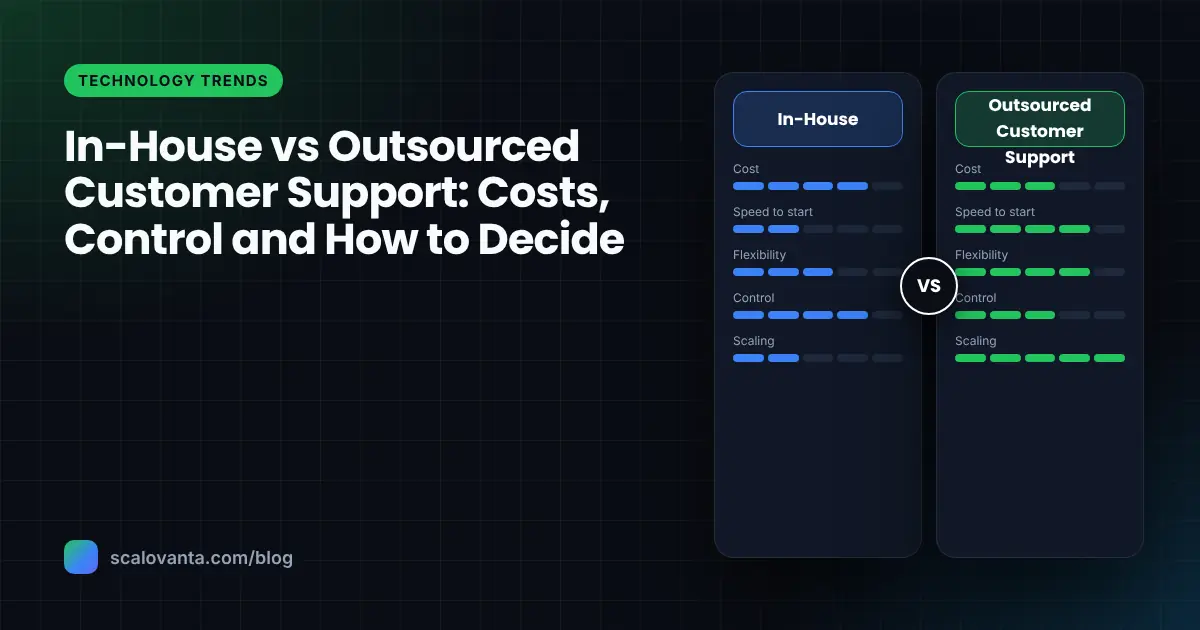
Side-by-side comparison
- Speed to start: in-house takes weeks to months; outsourced typically starts within a week or two.
- Cost structure: in-house is mostly fixed; outsourced is variable and easier to scale up or down.
- Coverage hours: 24/7 in-house is expensive; outsourced providers cover multiple time zones as standard.
- Product knowledge: in-house is usually deeper; outsourced improves with good documentation and a dedicated team.
- Control and culture: in-house is fully yours; outsourced is shared, managed through SLAs, QA and regular reviews.
- Management load: in-house sits with you; outsourced sits mostly with the provider's team lead.
When in-house is the better choice
- Your product is highly technical and most tickets need engineering knowledge.
- Support conversations are a core part of selling, such as high-value B2B accounts with long relationships.
- Regulations require that only your own staff can access certain customer data.
- Your volume is low and steady, and someone on the team already has time to handle it well.
When outsourcing is the better choice
- Volume is growing faster than you can hire, or it spikes around launches, sales and holidays.
- Customers expect replies in the evening, at weekends or across US and UK time zones.
- Most tickets are repeatable: order status, returns, billing, account access and product questions.
- You want founders and managers to spend their time on the product and growth instead of scheduling shifts.
How to protect quality if you outsource
Most outsourcing problems come from rushed onboarding and vague expectations. Protect quality by agreeing these points before you start:
- Written SLAs for first response and resolution time on each channel.
- Tone of voice and macros approved by you, not invented by the agents.
- Clear escalation rules: which refunds, complaints or legal issues come back to your team.
- Weekly QA scorecards based on real conversations, plus CSAT after resolved tickets.
- Access controls: agents work in your helpdesk with only the permissions they need, and an NDA and data processing agreement are signed.
- A named team lead who reports to you every week and owns improvements.
Try before you decide
The fastest way to settle the in-house versus outsourced question is to test it on your own customers. A short trial shows you real response times, tone and QA scores without a long contract. At Scalovanta, our free one-week trial lets expert agents handle part of your real chats or emails inside your own tools, and you get a report at the end of the week to compare against your current setup.
A simple decision checklist
- How many conversations do you receive per week, and how much does that vary by season?
- What hours do customers expect replies, and in which time zones?
- What share of tickets could a trained agent answer with good documentation?
- How much management time can you realistically give a support team each week?
- What would it cost you, in reviews and lost sales, if response times slipped during your next peak?
If most answers point to growing, repeatable volume across long hours, outsourcing or a hybrid model will usually serve customers better. If your support is deeply technical and closely tied to your product team, keep the core in-house and consider outsourcing only overflow and out-of-hours coverage.